
What is the difference between strip footings and slab footings?
Strip footings and slab footings serve different foundation purposes in Newcastle construction:
Strip Footings (Continuous Footings):
- Continuous concrete beams (400-600mm wide, 200-400mm deep) running beneath load-bearing walls only
- Support brick veneer homes, retaining walls, and structures with defined wall lines
- Ideal for Newcastle’s sloping terrain through stepped construction
- Require a separate floor slab installation
- Best suited for stable to moderately reactive Class A-M soils
- Cost-effective for traditional brick veneer construction
Slab Footings (Raft/Waffle Slabs):
- Large concrete mat covering the entire building footprint, integrating footing and floor
- Distribute loads across the full area, ideal for highly reactive Class H-E soils common in western Newcastle suburbs
- Single-pour construction reduces installation time
- Better for flat sites with poor bearing capacity
- More suitable for open-plan modern homes
Newcastle builders typically choose strip footings for traditional brick veneer homes on stable ground, while waffle slabs suit reactive clay areas requiring ground distribution.

How Strip Footings Differ from Other Foundation Systems
Strip footings provide continuous wall support, unlike pad footings that support individual posts. They’re also separate foundation and floor systems, different from slab footings that integrate everything in one pour. This makes them perfect for structures with defined wall lines, like brick veneer homes and retaining walls.
They’re the proven foundation system used in roughly 70% of Newcastle’s residential construction. The construction process involves trenches excavated beneath wall lines, reinforcement installed, and then concrete poured, creating that continuous beam. Every strip footing must be designed by an engineer for specific soil conditions per AS 2870-2011—no shortcuts, no guesswork. This requirement protects you from the structural failures we see with improperly designed footings.
Strip footings remain the go-to choice for the majority of Newcastle brick veneer homes because they work, they last, and when built correctly for our local conditions, they prevent the problems that cost homeowners serious money down the track.
Strip Footing Applications in Newcastle
Engineer Design Requirements for Newcastle Strip Footings
Technical Specifications and Dimensions: Footing width gets determined by soil bearing capacity and wall loads—typical residential 400-600mm, commercial up to 900mm+. Depth minimum 300mm, deeper on reactive soils (450-600mm common Class M-H sites). Reinforcement: 4x N12 or N16 longitudinal bars, R10/R12 stirrups at 600mm centres. Concrete grade minimum N20, N25 preferred for coastal durability.
Newcastle Soil-Specific Considerations: Reactive clay soils (Class M-H western suburbs) require deeper footings extending below the moisture variation zone, typically 600mm+ depth. Stepped footings on sloping sites maintain adequate depth at each level. Thickened sections at corners need additional reinforcement. Coastal areas require enhanced concrete durability for salt exposure resistance.
AS 2870 Compliance Requirements: Site classification determines minimum footing dimensions (Class A through Class H-E). Engineer certification is required for Class M+ reactive sites. Footing design varies dramatically between stable Class A coastal sites and highly reactive Class H western suburbs like Thornton and Beresfield. Inadequate width or depth causes differential settlement and wall cracking.
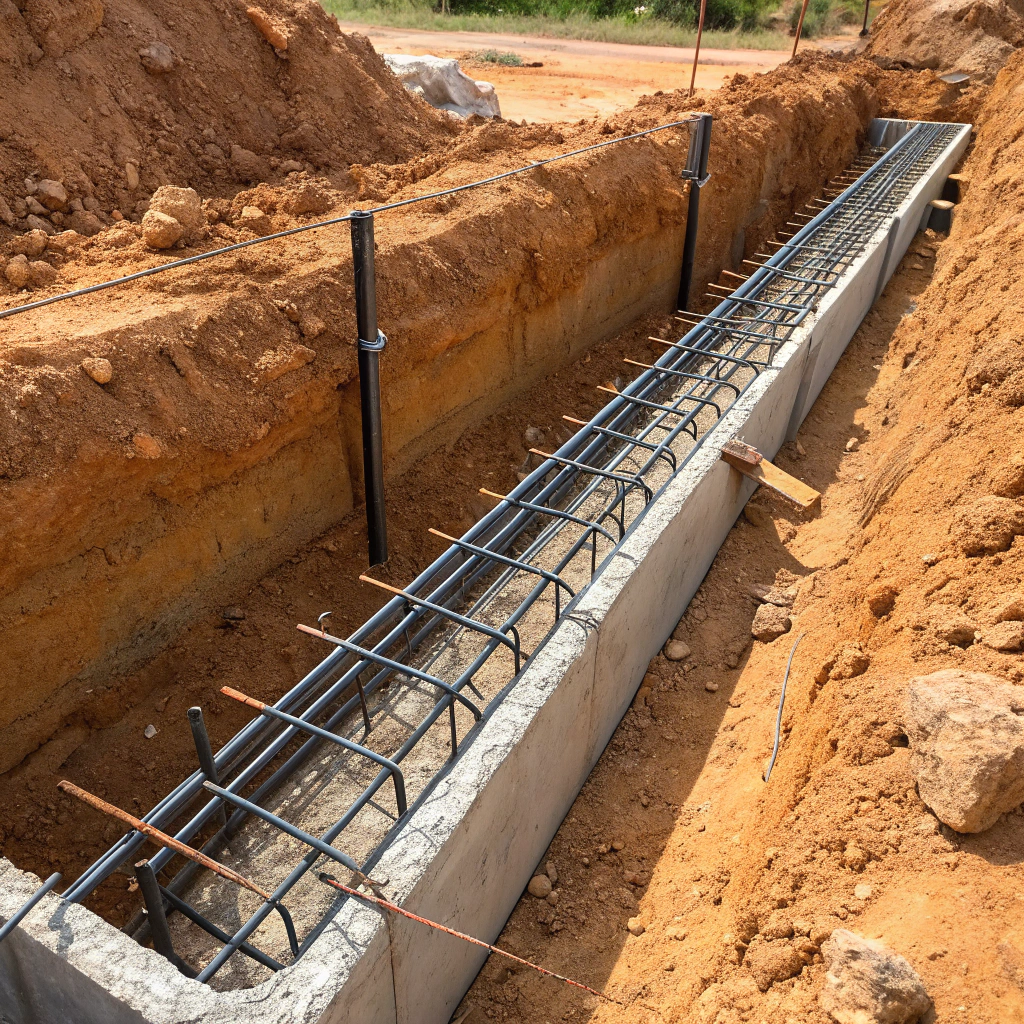
Our Strip Footing Construction Process
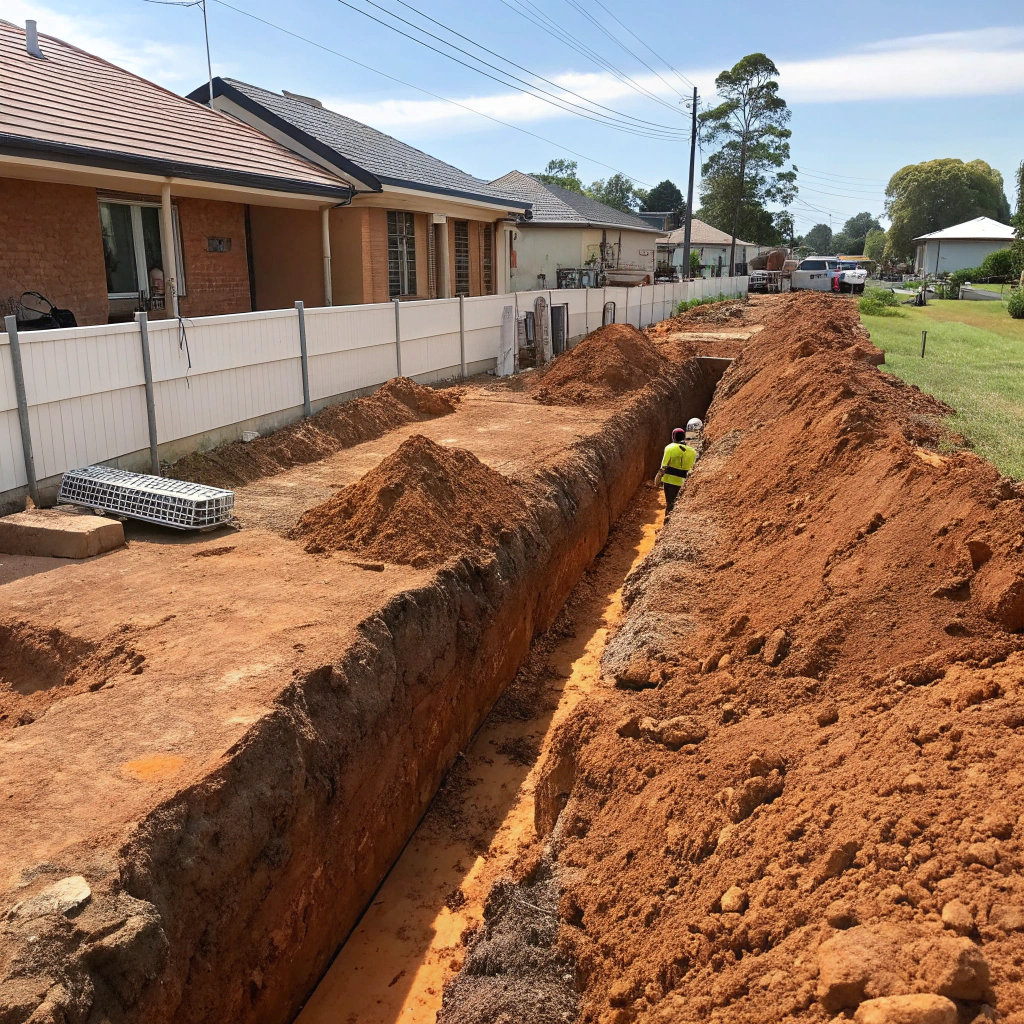
Pre-Construction and Excavation: The engineer’s footing design review and specification analysis come first. Site marking outlines precise footing trench locations on the engineer drawings. Excavation to specified depths creates level-bottomed trenches, stepped on slopes. Trench wall trimming, neat and square, maintains specified dimensions. Unsuitable material removal achieves a stable bearing surface, preventing future settlement.
Reinforcement and Concrete Placement: Reinforcement cage construction with correct bar sizes, spacing, and configuration. Installation maintains specified depth and position—typically 50mm minimum cover to base. Formwork installation for above-ground portions, if applicable. Concrete placement ensures complete filling without voids or honeycombing. Vibration consolidates concrete around reinforcement, eliminating air pockets that compromise strength.
Finishing and Quality Control: Strike-off and levelling create a flat top surface for wall construction. Curing protection—plastic sheeting or curing compound—maintains moisture for strength development. Engineer inspection before wall construction commences is required for Class M+ sites. Building certifier approval confirms AS 2870 compliance. Attention to detail, maintaining reinforcement cover, prevents corrosion, compromising structural capacity long-term.
Benefits and Newcastle Expertise
Structural and Cost Advantages: Continuous support along the entire wall length prevents differential settlement. Cost-effective for linear structures compared to individual pad footings. Suitable for various wall materials: brick, concrete block, stone, and rendered masonry. Accommodates wall heights from standard residential to substantial retaining walls through stepped construction on slopes.
Long-Term Performance Benefits: Prevents common problems: wall cracking from settlement, moisture penetration at the wall base, and structural movement. Proven foundation system with decades of successful performance in Australian conditions. Maintenance-free foundation system, unlike timber stumps, which require replacement. When properly designed for Newcastle’s reactive soils, it provides reliable decades-long performance.
Local Newcastle Knowledge: Extensive experience with reactive Newcastle soils (Class M-H sites) requiring reinforced footings at appropriate depths. Knowledge of local geotechnical conditions: coastal sand areas (Stockton, Newcastle East), stable clay sites (inner suburbs), reactive clay belt (western suburbs). Expertise in managing Newcastle’s hilly terrain through stepped footing construction in established neighbourhoods.



Why Choose A1 Concreters for Strip Footings in Newcastle
Our team works closely with local structural engineers and building certifiers who know Newcastle’s geotechnical challenges, ensuring your strip footings meet AS 2870 standards from day one.
✓ Local Soil Expertise – Deep understanding of Newcastle’s soil classifications from coastal Class A sites to highly reactive Class H western suburbs
✓ Engineer Coordination – Established relationships with trusted Newcastle structural engineers ensuring compliant footing design
✓ AS 2870 Compliant – All strip footings constructed to current Australian standards with proper certification and documentation
✓ Reactive Soil Experience – Extensive work on Class M-H sites requiring deeper footings below moisture variation zones
✓ Sloping Site Specialists – Expert stepped footing construction for Newcastle’s hilly terrain in Merewether, Hamilton South, Kotara
✓ Quality Materials – Minimum N25 grade concrete for coastal durability, correctly sized reinforcement per engineer specifications
✓ Transparent Pricing – Detailed quotes covering excavation, reinforcement, concrete, and inspections with no hidden costs
Common Questions About Strip Footings
How deep should strip footings be in Newcastle?
We typically construct strip footings 450-600mm deep on Newcastle’s reactive clay soils, though it depends on your specific site classification. For coastal areas with stable soils, 300mm might be adequate, but western suburbs like Wallsend and Fletcher usually need deeper footings. We’ll have an engineer assess your site to determine the exact depth required.
What's the cost of strip footings in Newcastle?
Strip footing costs vary based on how much linear metreage you need, the footing dimensions, and your soil conditions. Difficult access or reactive soils requiring deeper footings increase costs. We provide detailed quotes after assessing your specific site, so you know exactly what you’re paying for before we start.
Do I need an engineer for strip footings?
Yes, if you’re building on Class M or higher reactive soils, which covers most of Newcastle’s western suburbs. The engineer designs your footings to AS 2870 standards based on your specific soil test results. We work with trusted local engineers who understand Newcastle’s soil conditions.
How long do strip footings take to construct?
Most residential strip footing projects take us 2-4 days from excavation through to concrete placement. After that, you’re looking at a 3-7 day curing time before wall construction can start. Weather and the size of your project affect timing, but we’ll give you accurate timeframes upfront.
Can strip footings be used on sloping sites?
Absolutely. We construct stepped strip footings that work perfectly on Newcastle’s hilly terrain. Each step maintains proper depth, so your footings perform correctly at every level. We’ve done hundreds of sloping sites in Merewether, Hamilton South, and Kotara where stepped footings are standard.
What happens if strip footings aren't deep enough?
Inadequate depth on reactive soils leads to seasonal movement, causing wall cracks, sometimes severe structural damage. We’ve seen walls crack within 12-18 months when footings weren’t designed properly for Newcastle’s clay soils. That’s why engineer involvement isn’t optional—it prevents expensive repairs later.
Can you match existing strip footings for extensions?
Yes, we regularly construct strip footings for house extensions that integrate with existing foundations. We’ll assess your current footings, match the specifications where appropriate, and ensure new footings tie in properly. The key is maintaining consistent support so your extension doesn’t settle differently from your existing home.
Ready for Expert Strip Footing Construction in Newcastle?
A1 Concreters Newcastle delivers engineer-approved strip footings for all residential and commercial applications. From house extensions to retaining walls, we construct compliant strip footings designed for Newcastle’s reactive soil conditions.
✓ AS 2870 compliant construction
✓ Engineer-designed footings for Newcastle soils
✓ Experienced with Class A to Class H reactive sites
✓ Residential, commercial & retaining wall applications
✓ Free quotes with site-specific recommendations
Get Your Free Strip Footing Quote Today
Call 0482085820 – Speak to Newcastle Strip Footing Specialists
